

Read Hair Research Without Borrowing the Wrong Claims
A paper finds that one comb spacing performs best. The tempting conclusion is that you should buy that spacing. Before you do, ask a less obvious question: best at grooming, or best at making a laboratory test distinguish between treatments?
Those are different objectives. Understanding the difference can save a professional groomer from buying the right tool for somebody else's experiment.
A useful example from detangling research
A 2025 study developed a way to compare detangling treatments on prepared human-hair tresses. It selected 4 mm comb spacing because that spacing helped separate the treatments' results with relatively low variation in the experiment. The researchers also defined an endpoint at 9.8 N and measured how far a comb travelled before reaching it, relative to tress length. These were choices for a measurement method—not a recommendation to use a 4 mm comb on a dog or to pull a dog's coat to that force. Read the original methods and results.
That is the central distinction: a test can be good at detecting a difference without identifying the best everyday grooming technique.
Read the denominator before the headline
Whenever an improvement is expressed as a percentage, work out what was counted. A reduction in peak combing force, fewer broken fragments and a greater distance before a laboratory endpoint are not interchangeable outcomes.
Ask for the starting value and the comparison. “Improved by 30%” is incomplete if you cannot tell whether it refers to one prepared sample, an average across several samples or the number of people who preferred a finish.
A laboratory difference may be meaningful for product development while saying little about appointment length, a dog's tolerance or the quality of a finished outline.
Check five details before borrowing the claim
| Detail | Question for a grooming decision |
|---|---|
| Material | Human hair, synthetic fibre or the canine coat type I actually work on? |
| Preparation | Wet or dry, treated or untreated, deliberately tangled or naturally presented? |
| Tool and movement | Which pin geometry, section size, travel direction and repeated motion? |
| Outcome | Force, breakage, finish, comfort or time—and how was it measured? |
| Comparison | Compared with what, under which conditions, and with how much variation? |
These questions are a reading framework, not a reason to dismiss research. They let you use a result at the level it supports.
Keep the living subject in the decision
A detached tress cannot withdraw a foot, change its stance or show discomfort. A repeatable laboratory endpoint is therefore not a substitute for the handling decisions you make with an individual dog.
Do not recreate a force test in the salon. Select suitable equipment, stop at resistance or discomfort, and investigate unexpected changes. A useful clinical question belongs with the client's vet; a useful equipment question belongs with the manufacturer or an appropriately supervised practical comparison.
Translate the evidence into a better buying question
Instead of “which comb has the scientific spacing?”, ask “which working span and pin arrangement gives me controlled access to this coat and task?”
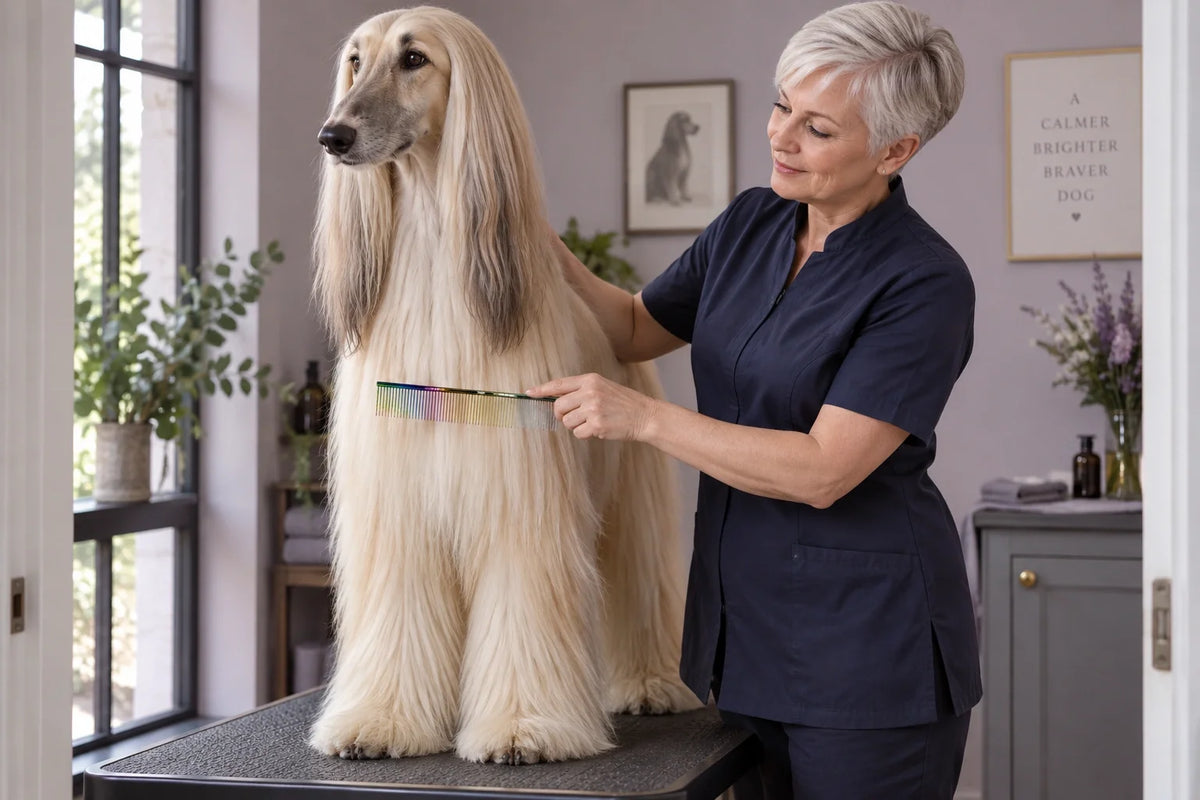
The VUNRO 9.5-inch Lux Coarse and Fine Comb, shown here, provides a long working span and two spacing regions. It is an option for appropriate larger sections. The 5-inch Coarse and Fine Straight Comb offers a more compact alternative, while the 7-inch Lux Pintail Comb has a distinct sectioning role. None was tested in the cited paper.
Build a set around those different jobs. Do not infer that the longest tool, the finest spacing or the highest claimed removal rate is automatically the most useful choice.
Ask for evidence you could act on
If a supplier claims a practical advantage, ask for the test conditions and the result that matters to your work. If the evidence is a user preference survey, call it that. If it is a mechanical test, keep the tested material and method attached to the claim.
You can then make a modest, useful decision: try a suitable tool for a defined task, allow familiarisation and assess the finish as well as the time. Our salon trial guide explains how to make that comparison more informative.
Source and scope
Song and Son, Hair Detangling Evaluation Method Using Section Detangling Rate, Cosmetics, 2025. The article above applies critical-reading questions to purchasing decisions; it does not transfer the paper's experimental endpoints to dogs.
Keep learning
More from the Blade Blog

Separate a Dry Surface from a Dry Coat
Read the guide →
Check the Outline in Motion Before Making Another Cut
Read the guide →


